AFTERIMAGE
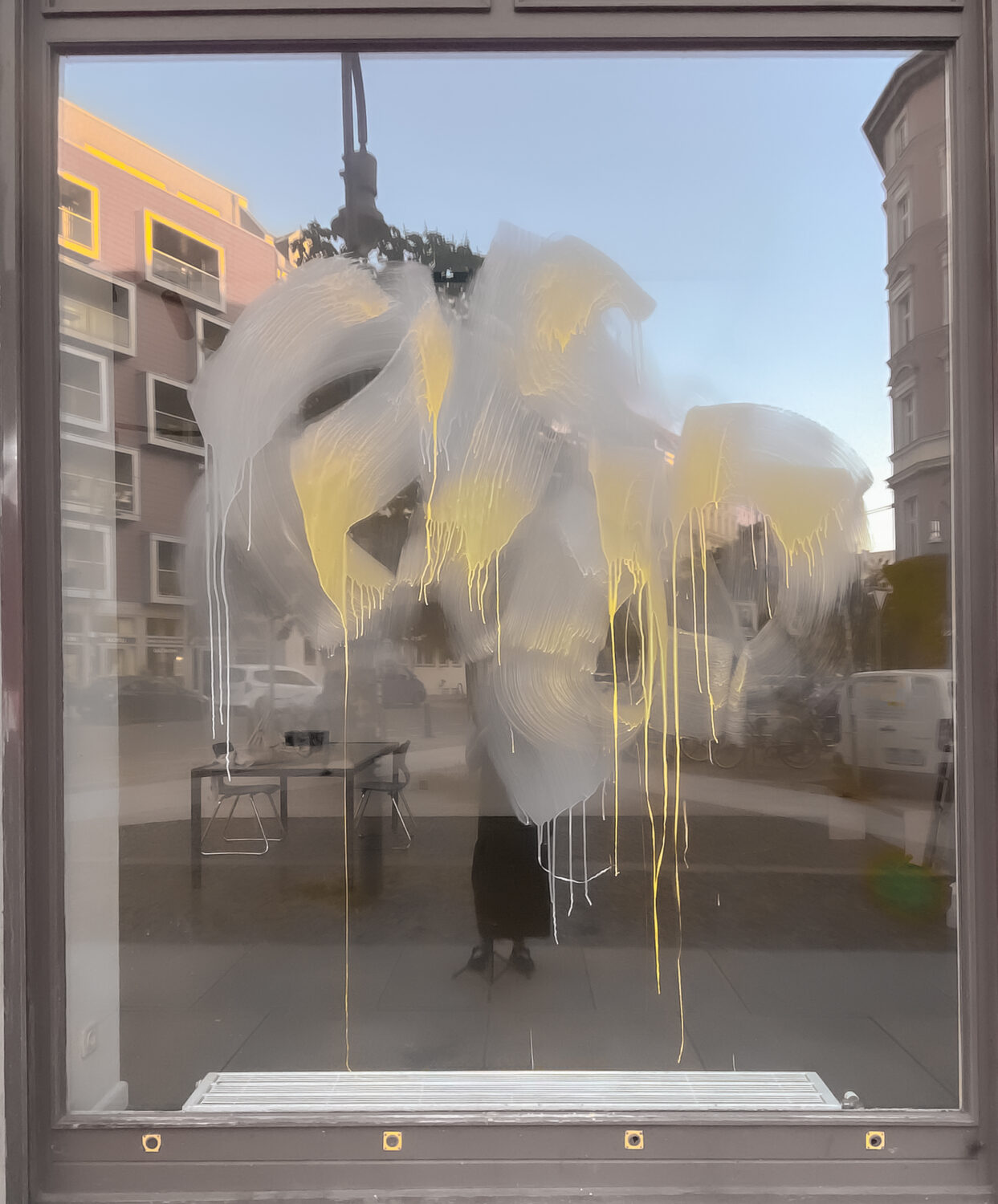
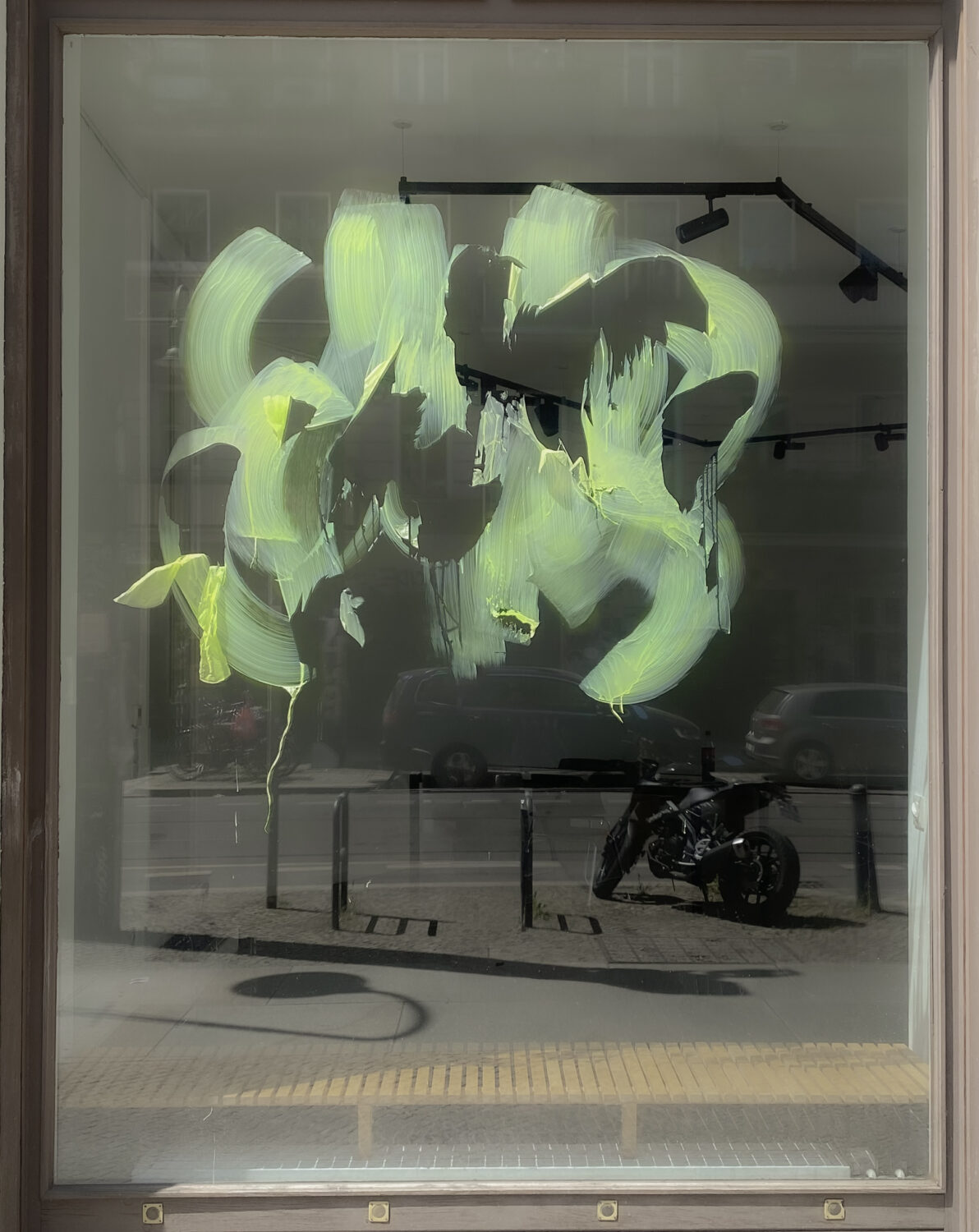
AFTERIMAGE is being developed further at different architectural and social thresholds. The temporary works of writing emerge on windows, glass façades and reflective surfaces. The investigation considers different spatial situations, vocabularies, weather patterns and stages of dissolution. Scale, legibility, viewing direction and the relationship between interior and exterior change in the process. The works’ emergence and disappearance are documented through photography or film, without the documentation replacing the work itself.
The starting point is an observation about the fragility of language: when democratic structures erode, the terms that sustain social spaces are the first to shift. Before a right is lost, the word that names it loses its authority: it is replaced, reinterpreted, flagged for review or quietly removed from administrative vocabulary. This form of erasure rarely declares itself as censorship. It appears as an absence rather than a prohibition: as a gap, as something no longer provided for. This is precisely where Afterimage begins. Its source material consists of documented cases of administrative control over language in the United States: terms relating to equality, science, health, gender, minority protection and climate that have been avoided, replaced, removed or flagged in government contexts since 2017 and again from 2025 onwards. A vocabulary of what is at risk, which the series translates into a painterly process rather than simply quoting.
The paint is applied with a brush, on glass. On windows, panes and façades. Word by word, the writing is layered and overwritten until legibility gives way: a palimpsest in which the newest layer conceals the older one without erasing it completely. In this transition, the semantic level falls away: what begins as writing passes into the rhythmic logic of gesture. The paint holds the trace while meaning slips away; the mark becomes a dense field of colour and resonance. The brushstroke functions less as an expressive gesture than as an indexical mark: a record of a process, evidence of a movement that has taken place. Afterimage thus operates within the expanded field of painting: less an image than a process, less a statement than a practice of tracing.
The paint is water-soluble and biodegradable. Depending on the weather, it dissolves on its own, washed from the glass by rain or a thunderstorm. Drops become bands drawn out by the wind; the writing runs before it can settle. What the hand lays down with the brush, the weather takes back. Authorship thus shifts towards the process: the weather becomes a co-author, disintegration a part of the work. Afterimage does not archive the erased terms to protect them from disappearance; the work shares their fate. It enacts erasure rather than merely asserting it. This is a deliberate rejection of the permanent object and the gesture of preservation: instead of constructing an archive against forgetting, the series adopts transience as its form. The paint’s return to the material cycle without leaving a residue gives this stance an ecological grounding without reducing it to a question of materials. Disappearance remains politically coded.
The title contains the series’ central figure of thought. An afterimage is the optical phenomenon that remains after the stimulus has been withdrawn: an image without an object, persisting solely in perception. Applied to the erased terms, this means that what is administratively removed continues to act as an afterimage, resonating in the affect and memory of those who once saw it. The work bears witness through a trace, but a trace that itself fades. Viewers thus become the final place where the image endures: in the afterimage rather than on the glass. This hauntological structure, presence as absence and the continued effects of what has been withdrawn, brings Afterimage into dialogue with contemporary investigations of memory, the archive and its gaps.
The use of glass as the support, whether a window, pane or façade, is part of the work’s argument. Glass brings a threshold to the centre that is both architectural and metaphorical. The window separates and connects inside and outside, private and public, the sheltered interior and the street. It is where a house, an institution or a community decides what to reveal to the outside and what to keep closed: transparent, yet still a boundary. Applied to this membrane, the removed terms become legible as what they are politically: words that open or close social spaces and help determine who enters and who remains outside. The writing appears on both sides at once, reversed from inside and readable from outside, so that the same term differs depending on whether one stands within the space or in front of it. It is the outer surface that is exposed to the weather: dissolution takes place at the boundary where the interior meets the outside. The political space named by the words and the physical space marked by the glass become one.
The words used come from documented cases of administrative control over language in the United States, including diversity, equity, inclusion, equality, gender, gender identity, transgender, trans, non-binary, LGBTQ, women, race, ethnicity, disability, vulnerable, underserved, underrepresented, environmental justice, climate crisis, evidence-based and science-based.
Afterimage intertwines layering, fragment and affect to create a pictorial space in which visibility and dissolution can be experienced at the same moment. The serial approach corresponds to this experience: erosion is an ongoing condition rather than an event, and each work is an individual finding within a recurring process. At a time when the politics of visibility and the contested status of language have become central questions in contemporary art, the series positions painting itself, this slow, hand-guided, embodied medium, as a seismograph of that erosion. And it chooses transience over the gesture of holding on: a precise response to what it reveals, rather than an act of resignation.
Ongoing series since 2025
Sources
zeit.de – US Centers for Disease Control and Prevention (CDC): banned words
pen.org/banned-words-list
opm.gov – OPM memorandum, 29 January 2025
https://www.zeit.de/politik/ausland/2017-12/us-seuchenbehoerde-cdc-verbotene-woerterhttps://pen.org/banned-words-list/https://www.opm.gov/media/yvlh1r3i/opm-memo-initial-guidance-regarding-trump-executive-order-defending-women-1-29-2025-final.pdf